
Top Snyk Alternatives That Include AI Pentesting & DAST Management
Traditional penetration testing happens once or twice a year. A team waits weeks for a report. By the time results arrive, the code has changed. New vulnerabilities have appeared. The report becomes a historical document, not a security tool.
DAST tools fill some of the gaps. They scan running applications continuously. But they miss business logic flaws, authorization issues, and chained attacks. Human pentesters catch these things. Humans also cost thousands per day and cannot scan every code change.
AI pentesting sits between these two worlds. It runs continuously like DAST. It reasons about application behavior like a human tester. The platforms below combine DAST scanning with AI agents that validate vulnerabilities, test business logic, and sometimes even fix what they find.
This list looks at three Snyk alternatives that include AI pentesting and DAST management.
1. Aikido
Among Snyk alternatives, Aikido stands out for AI pentesting through its Infinite product. The system deploys autonomous hacking agents after every software change. These agents do not just scan. They attack.
Each code change triggers agentic pentesting agents that discover risk, validate exploitability, apply remediation where safe, and retest to confirm risk reduction. Aikido claims this level of exhaustiveness would be difficult to replicate even with large in-house security teams.
How Aikido Infinite works:
- Agents pursue every possible attack route across the application’s surface area
- They identify undocumented endpoints and hidden logic paths
- The system validates every finding with proof of exploitability
- Remediation happens within the same workflow
- Agents learn from each deployment, improving detection over time
In a survey of 500 security leaders, 76% deployed production changes weekly or faster. Only 21% of security was validated on every release. Another 85% said security findings were outdated by the time reports arrived. Aikido Infinite closes this gap.
The platform’s model-agnostic architecture combines AI with proprietary exploit validation and controlled runtime execution. Aikido’s AI pentesting capability has uncovered complex vulnerabilities that experts previously missed.
For DAST, Aikido includes traditional dynamic scanning as part of its unified platform. The system monitors applications and APIs for SQL injection, XSS, and CSRF vulnerabilities. It supports authenticated DAST and scans every API endpoint.
Companies using Aikido include the Premier League, Revolut, and SoundCloud. The platform charges a flat monthly fee covering DAST, AI pentesting, and all other security modules.
2. Burp Suite (PortSwigger)
Burp Suite has been a standard tool for web security testing for years. PortSwigger recently introduced Burp AI, adding AI-powered features to both Burp Suite Professional and Burp Suite DAST.
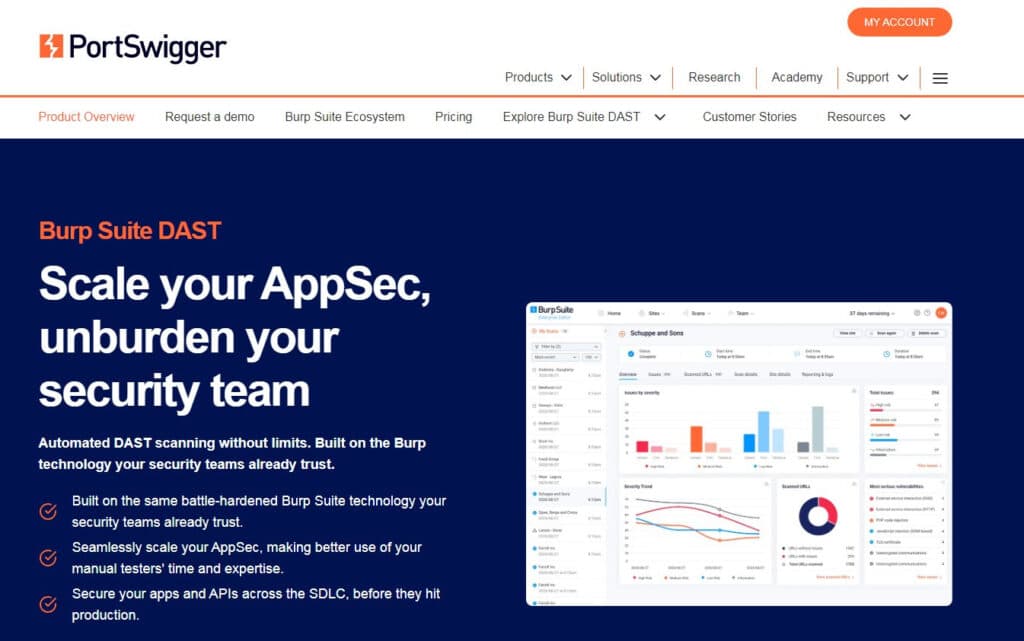
AI-enhanced scanning automatically investigates issues found during a scan. Burp AI checks each issue to determine whether it represents an exploitable risk. The system returns detailed evidence and remediation steps. This makes triage faster and easier.
Burp AI features:
- AI-enhanced scanning validates scanner findings and filters false positives
- Explore Issue performs automated follow-up investigations on vulnerabilities
- Explainer provides security-focused explanations of HTTP requests and responses
- AI-powered recorded logins generate authentication sequences automatically
- The Montoya API enables AI features in custom extensions
In Repeater, Burp AI operates through tasks. Each prompt creates a task logged in the Tasks pane. The system does not retain conversation history. Every task produces logs of HTTP traffic generated during the investigation. Testers can replay and validate every AI action.
For DAST, Burp Suite DAST includes traditional scanning capabilities. The AI features layer on top, investigating findings after the scan completes. Users can configure which severity and confidence combinations trigger AI investigation.
Pricing and credits:
Burp AI requires AI credits. Credits are consumption-based and expire after 12 months. Credits cannot be pooled across users. Each user needs their own credits.
The AI features comply with ISO 27001 standards. Data is encrypted in transit and at rest. AI providers do not store the data they process.
For teams comparing a top security firm vs Snyk alternatives, Burp Suite offers established DAST with AI investigation on top. The platform serves security professionals who want fine-grained control over testing workflows.
3. Acunetix (now part of Invicti)
Acunetix has been in the DAST market for over 20 years. The platform pioneered automated web application security scanning. Today, Acunetix combines its DAST engine with AI innovations that close the gap between automated scanning and manual penetration testing.
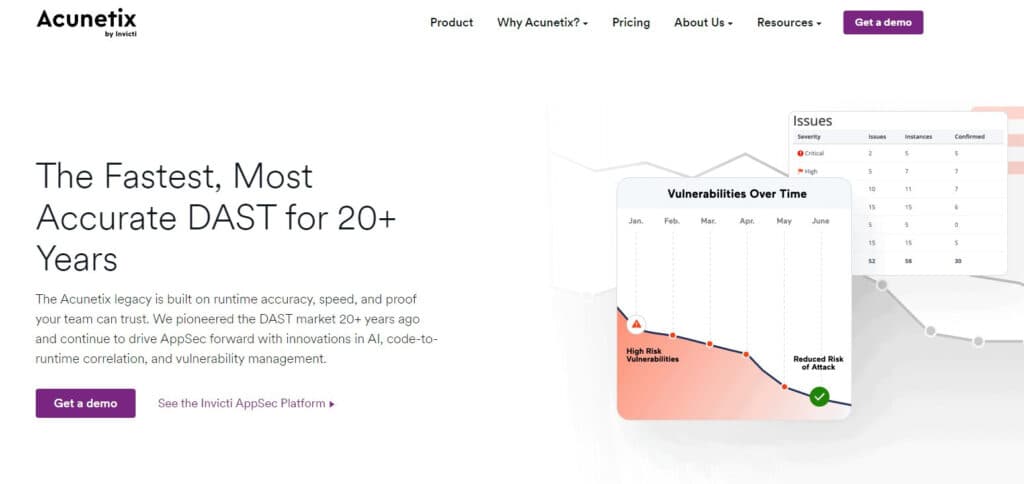
The scanner detects over 12,000 vulnerabilities, including SQL injection, cross-site scripting, and zero-day vulnerabilities. It uses blended DAST and IAST scanning techniques to identify security flaws across different application types.
Acunetix AI and proof-based features:
- AI-driven risk scoring predicts risk using 200+ signals before scanning begins
- Proof-based prioritization applies runtime reachability and exploitability analysis
- 99.98% confirmation accuracy for exploitable vulnerabilities
- 70% acceptance rate on AI remediations
- Identifies specific lines of code requiring fixes
The scanner performs automated discovery and crawling of websites, applications, and APIs. It creates an inventory of assets requiring security assessment. The tool supports scanning of password-protected areas through macro recording and can detect unlinked files and API endpoints.
Agentic pentesting capabilities:
Invicti (Acunetix’s parent company) offers multi-agent attack simulation. Specialized AI agents work in parallel to execute real-world attack strategies. They generate tailored attack plans that evolve based on application behavior and findings. The system uncovers chained exploits and contextual vulnerabilities that traditional scanners miss.
For organizations looking for Snyk alternatives for cloud and web applications, Acunetix focuses exclusively on runtime testing. The platform does not include SAST or SCA. It integrates with CI/CD pipelines, issue trackers, and web application firewalls.
Pricing starts at $4,500 per year for a single domain license. On-premise and cloud versions are available.
Quick Comparison
Three platforms, three different approaches to AI testing. One runs agents after every code change. Another adds AI to existing DAST workflows. The third offers agentic simulation with enterprise-grade accuracy. Here is how they compare.
| Platform | AI Pentesting | DAST Included | Validation Method | Remediation |
| Aikido | Continuous agents on every change | Yes | Exploit validation plus optional fixes | AutoFix PRs |
| Burp Suite | AI-enhanced scanning (credits) | Yes | AI investigation after scan | Remediation steps |
| Acunetix | Agentic multi-agent simulation | Yes | Proof-based with 99.98% accuracy | AI remediation guidance |
The table reveals clear trade-offs between continuous testing, AI assistance, and validation accuracy. Each platform excels in one area while making compromises in others.
FAQ
The questions below come from teams evaluating AI pentesting and DAST tools. These are the ones that keep surfacing in conversations with security engineers.
What is the difference between DAST and AI pentesting?
DAST scans running applications for known vulnerability patterns. AI pentesting reasons about application behavior, tests business logic, validates exploitability, and can chain multiple low-severity issues into a critical exploit.
Does Aikido Infinite replace traditional DAST?
No. Aikido includes both. DAST handles surface-level checks. AI pentesting handles deeper logic flaws. The two work together.
How does Burp AI handle false positives?
AI-enhanced scanning investigates scanner findings automatically. The system determines whether an issue represents a real, exploitable risk before reporting it.
Is Acunetix AI available in all plans?
AI features like predictive risk scoring and proof-based prioritization are included in current versions. Agentic pentesting is part of the Invicti platform.
Which platform finds the most vulnerabilities?
Acunetix claims 40% more vulnerabilities than other leading DAST products. Aikido Infinite has uncovered vulnerabilities that previously went undetected by experts. Each excels in different areas.
Why AI Changes the Pentesting Equation
DAST tools have been around for decades. They check for missing security headers, SQL injection patterns, and XSS payloads. These are syntax-level issues. The scanner sees what the application outputs, not why.
Human pentesters understand business logic. They know a user should not see another user’s invoice. They understand role-based workflows. They can chain a low-severity information leak with a misconfigured endpoint to access admin functions. DAST cannot do this.
AI pentesting bridges the gap. Systems like Aikido Infinite deploy agents that simulate real attackers. They navigate workflows, track server-side state, and test assumptions. An agent might notice that an endpoint requires a user ID. It knows it is authenticated as User A. It tests whether changing the ID to User B gets rejected. If not, the agent reports a broken access control flaw.
This is semantic analysis, not fuzzing.
Burp AI takes a different path. It augments existing DAST workflows rather than replacing them. AI-enhanced scanning investigates scanner findings after scans are complete. Explore Issue performs automated follow-ups on vulnerabilities. The system logs every action. Testers can replay and validate AI decisions.
Acunetix focuses on proof-based prioritization. The scanner confirms exploitability before alerting. With 99.98% confirmation accuracy, teams spend less time chasing false positives.
For organizations seeking affordable options in Snyk alternatives, each platform offers different trade-offs. Aikido includes AI pentesting in its flat monthly fee. Burp Suite requires separate AI credits. Acunetix includes AI features in its DAST product.
Among Snyk alternatives that include AI pentesting, Aikido Infinite stands out for continuous, autonomous testing on every code change. The system validates exploitability and provides remediation within the same workflow. For teams looking for Snyk alternatives for cloud and web applications, Aikido combines DAST, AI pentesting, and runtime protection in one platform.
Which Snyk alternatives have low noise? The ones that validate findings before reporting them. Aikido Infinite validates each finding with proof of exploitability. Acunetix achieves 99.98% confirmation accuracy. Burp AI investigates scanner findings automatically. Each platform reduces false positives differently. The common thread is validation.
Final Thoughts
AI pentesting changes the security testing equation. Instead of waiting for annual or biannual penetration tests, teams can validate every code change. Burp Suite adds AI investigation to traditional DAST workflows. Acunetix offers agentic simulation with proof-based validation.
But Aikido Infinite triggers autonomous hacking agents on every code push, validates exploitability, and closes the loop with AutoFix. One platform. Continuous testing. No waiting for reports.